
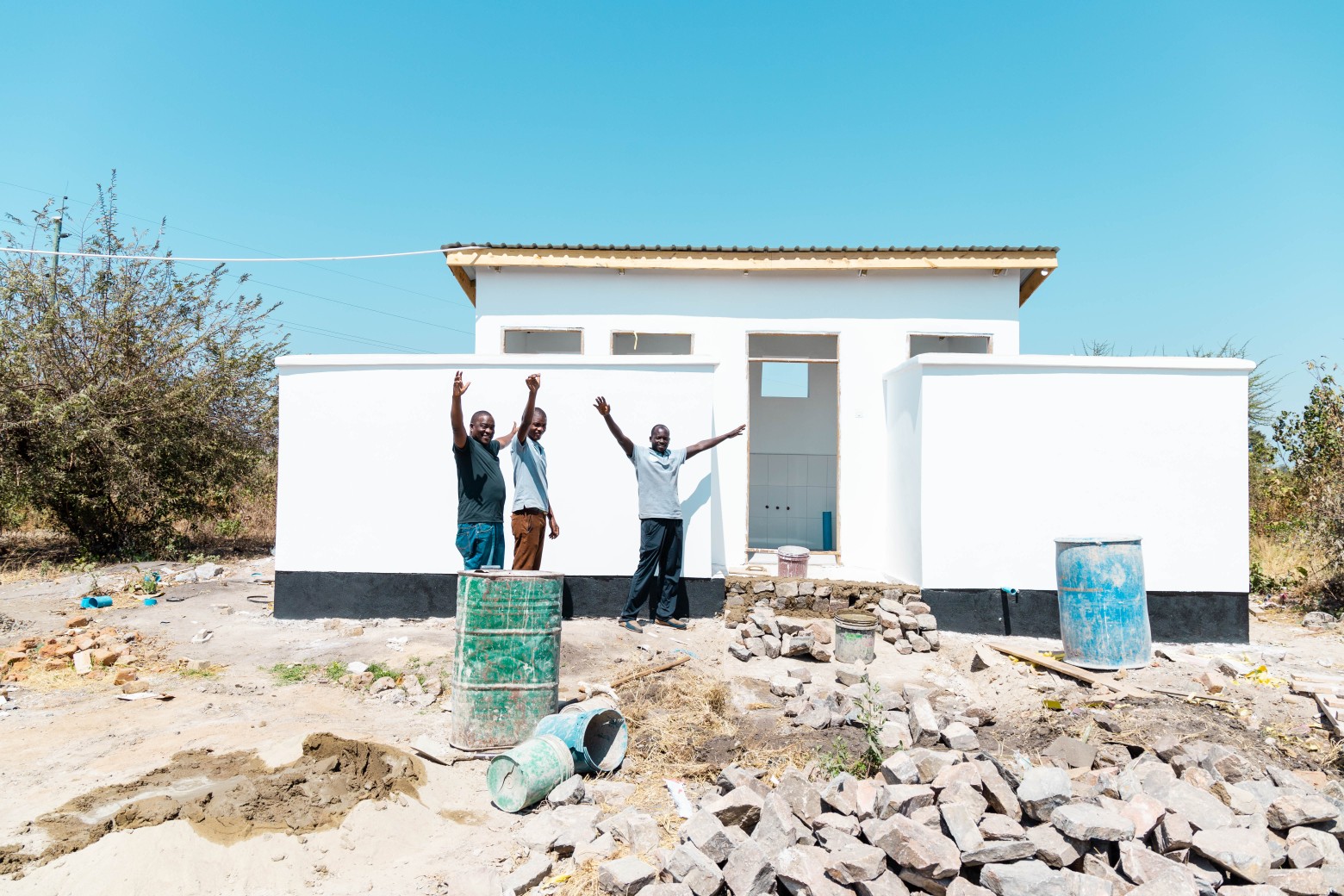
For many residents of Luchima Village in Majimoto Ward, distance makes it difficult to reach the village office and repeatedly follow up on public-service concerns. Sanitation was among the most immediate issues. Luchima Dispensary needed an external toilet facility that could offer patients greater privacy and dignity, while boys at Kamwanga Primary School had inadequate sanitation facilities.
Construction did not move consistently. Progress slowed, leaving the community uncertain about when the facilities would be completed and available for use. The challenge was therefore not simply identifying the need; it was maintaining attention, clarifying responsibility and ensuring that stalled work returned to the local development agenda.
Through the Raia Makini project, Community Accountability Champions (CACs) supported residents to articulate service-delivery concerns and relay them to the village government and other responsible authorities. This role was particularly valuable in Luchima because CACs were accessible within the community and could sustain follow-up after meetings ended.
CACs advocated for the external toilet at Luchima Dispensary, called for more regular technical supervision and kept the issue before village actors. At Kamwanga Primary School, they engaged the Head Teacher and village leaders when construction progress slowed, emphasising the inadequate facilities available to boys and the need to complete the six-latrine toilet block. CACs also used meetings with the Councillor on 3 April 2026 and the Member of Parliament on 20 April 2026 to raise sanitation and other local priorities.
By the August 2026 monitoring visit, both sanitation facilities were close to completion. At Luchima Dispensary, only minor finishing works remained, and the engineering department had followed up on construction quality. At Kamwanga Primary School, construction and roofing of the six-latrine toilet block had been completed, with minor finishing work still outstanding. Photo documentation confirmed the physical progress.
CACs did not finance or construct the facilities, and the progress cannot be attributed to their action alone. Their contribution was to keep community priorities visible, connect residents with responsible authorities, encourage dialogue among the school, village and council actors, and continue asking for action when implementation slowed. This is a meaningful shift from raising isolated complaints to sustaining an accountability process around concrete services.
Ultimately, the progress achieved in Luchima was made possible by the accessibility, persistence and collaborative approach of the CACs. As locally based actors, they provided residents with a nearby channel for raising concerns despite the village’s dispersed geography. They sustained follow-up when construction slowed and brought village leaders, school management, and council authorities into a shared accountability process.